
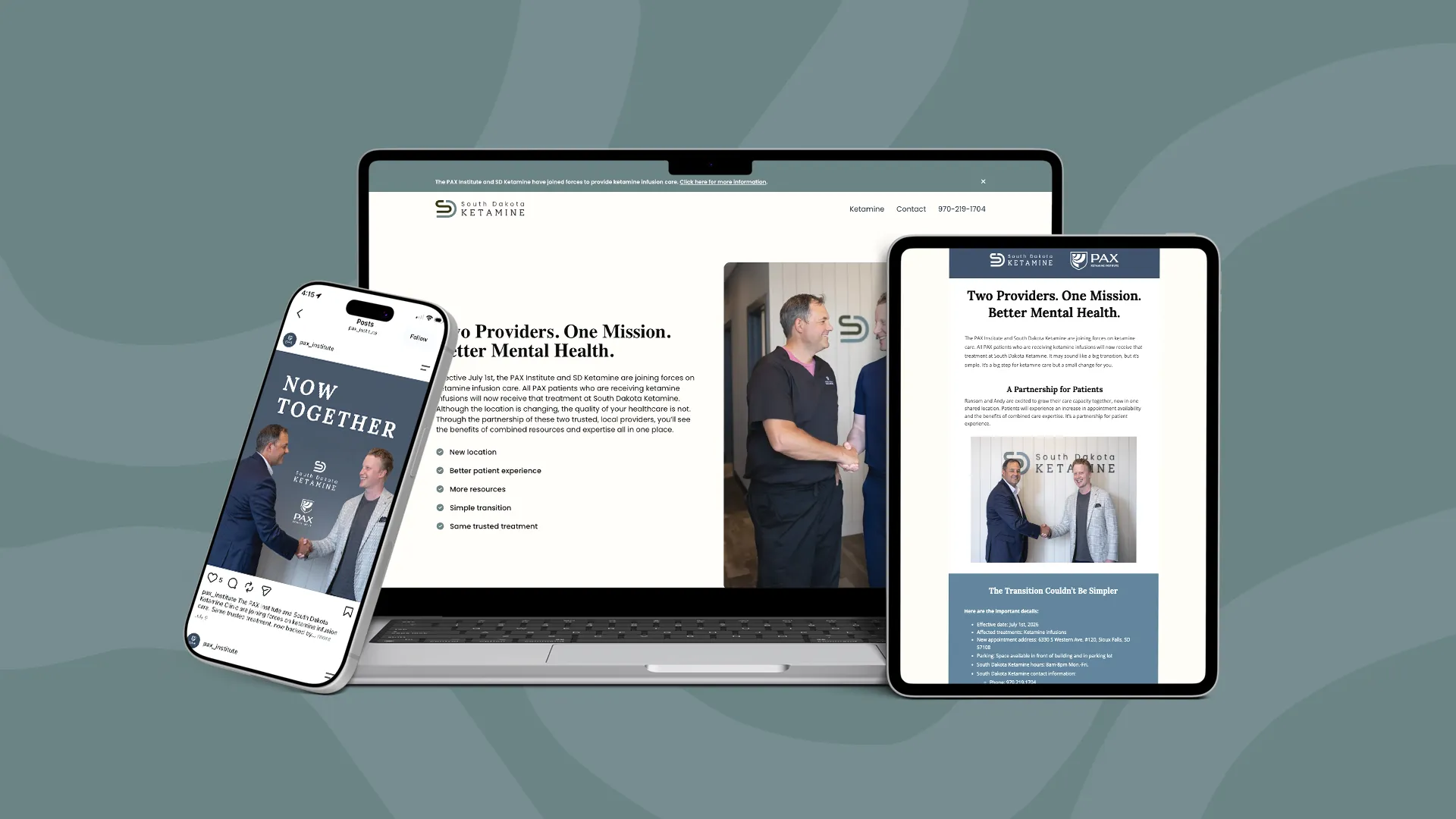
When two healthcare providers start working together, the clinical logistics are often the easy part. The harder question is a human one: will patients feel confident about the change?
When South Dakota Ketamine Clinic prepared to begin seeing patients from Pax Institute for IV Ketamine infusions, this was the question they brought to our team. They needed patients to learn about the change in the right way, from the right places, and at the right time. They also saw an opportunity. Pax Institute had already built real awareness in the market. Rather than letting that momentum sit idle, why not use the announcement as a launch pad to educate a much wider audience about what Ketamine therapy actually is and who it can help?
So the goal was twofold: reassure existing patients and reach new ones.
Strategy comes first
Before anyone wrote a subject line or designed a billboard, our team sat down together to build the plan, including messaging, channel mix, sequencing, and timing. We mapped two distinct audiences with two very different needs.
Pax Institute patients needed clarity and reassurance. They were already in the middle of a care journey, and the last thing anyone wants mid-treatment is uncertainty about where to go next. Every piece of communication we aimed towards this group had one job: make the change feel simple, expected, and stress-free.
Our messaging for the general public required a different approach. Most people have heard of Ketamine therapy without really understanding it, leading to a number of misconceptions and negative opinions. This audience needed educational material to help set the record straight before receiving a clear next step.
The rollout
Email Marketing Strategy: Rather than dropping a single announcement and hoping it landed, we built a sequence that walked Pax Institute patients through the transition over four weeks. Each email built on the last, answering the next logical question before patients had to ask it. Spacing the message out gave people time to absorb the news and gave the announcement more than one chance to be seen.
Social Media Strategy: We posted the news to the Pax Institute Facebook and Instagram pages, meeting patients where they were already following along instead of asking them to find a new account.
Billboard Strategy: The first billboard announced the partnership. Once that message had time to land, we swapped the creative for general brand awareness around Ketamine therapy. The same media buy did double duty: it informed the people who needed to know, then went to work attracting people who had never considered Ketamine treatment at all.
Website Strategy: We built a campaign landing page on the South Dakota Ketamine Clinic website so every channel had somewhere specific to send traffic. Anyone who saw a billboard, opened an email, or tapped a social post landed on a page built to answer their questions and make contacting the clinic easy.
Print Strategy: The final piece was a refreshed brochure explaining the treatments and what to expect. It gave the clinic something tangible for business development conversations and for anyone who called or walked in wanting to learn more.
The results
During the campaign, South Dakota Ketamine Clinic saw:
- A record-breaking month for patient volume, the highest number of patients seen in a 30-day period since the clinic opened
- A 53% increase in website traffic
- 176% more visits to their social media accounts
- 100% more social interactions and 100% more link clicks
- Double the conversions from their Google Ads campaign
This partnership announcement became the clinic’s single best month in its history.
Why using multiple channels makes a difference
Each one of these pieces is capable of providing value by itself. However, a lone piece of marketing material can only reach so far and is thus more likely to underperform. In this campaign, the email sequence worked because the website was reinforcing the same message in the background. The billboards brought traffic because there was a landing page ready to receive that traffic. The landing page drove conversions because the brochure and the social posts had already introduced the reader to the topic.
This coordination can only happen when your strategy is aligned across all channels. Copy, design, digital, and media should all work to serve a central goal. At Strategie, our entire team built the plan together, with every discipline in the room from the start. Strategists, writers, designers, and digital specialists shaped one plan instead of producing five disconnected deliverables.
Let’s talk about what that could look like for your business.